
Jogos para Atari 8-bit
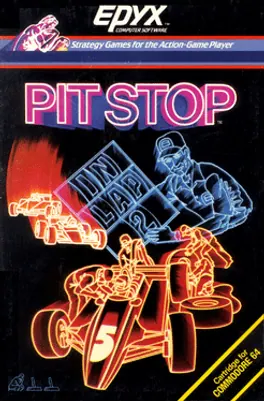
Pitstop
Pitstop is an action racing game featuring six different race tracks. Your goal is to earn as much money as possible by winning races in the Grand Circuit which consists of a race on each of the six tracks; each time a race is completed, you'll earn money based on how you placed and the number of laps completed before moving on. While you are racing, keep an eye on your tires and fuel; if your tires become too worn (causing a blowout) or you run out of fuel, the game will be over. To prevent this from happening, you'll need to make a pitstop. Here you control the pit crew and can replace tires and refuel. While in the pit the race is still going on, of course, so repairs need to be made as quickly as possible to get back into the race without losing too much ground. Several game options are available to control the level of difficulty and the number of laps. In addition to the Grand Circuit which is the full race, you can also practice a track in a single race or enter the mini circuit which consists of three races.
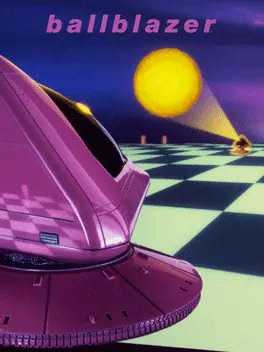
Ballblazer
Ballblazer is a 1984 computer game created by Lucasfilm Games (later LucasArts Entertainment). It was originally released for the Atari 8-bit systems, such as the Atari 800 and the Atari 5200. It was also ported to other popular platforms of the day, such as the Apple II, ZX Spectrum (by Dalali Software Ltd), Amstrad CPC, Commodore 64, Atari 7800, and the NES. The Atari 800 version was called Ballblaster during development - pirated versions of the game went by this name as well. The principal creator and programmer of Ballblazer was David Levine. In 1990, LucasArts and Rainbow Arts released a remake and follow-up to this game, called Masterblazer. This game was released for the Amiga, Atari ST, and PC DOS. A similar game inspired by Ballblazer called Space Football: One on One was developed and released by Triffix for the Super NES in 1992. Years later on March 31, 1997, a remake of the original titled Ballblazer Champions was released for the Sony PlayStation.
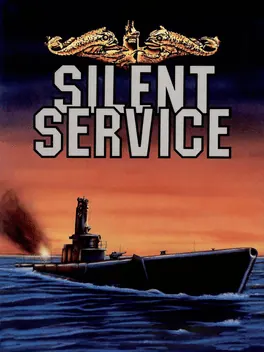
Silent Service
Exciting World War II Submarine Action in the South Pacific by Sid Meier. 0400 hours, Tuesday 1942... BATTLE STATIONS!! BATTLE STATIONS!! Enemy convoy identified on radar!! SILENT SERVICE, The Submarine Simulation, brings exciting action, great strategy, detailed graphics and an ultra-realistic simulation of a World War II U.S. submarine in the South Pacific. SILENT SERVICE's outstanding features include: all the critical battle stations 0 engine room, conning tower and ship's bridge; challenging and realistic combat versus single ships and heavily escorted convoys; and an infinite variety of situations using complete maps and charts for the entire South-west Pacific and a sophisticated and realistic attack plotting system. SILENT SERVICE is the most detailed and realistic submarine simulation for home computers. Player selected "reality levels" allow the player to customize complexity, and time scaling ensures that the actions and decisions are constantly required. SILENT SERVICE provides a wide selection of historical scenarios from individual attacks to patrol missions that bring challenge and fun to both the first time player and the experienced submarine veteran. Will you, as submarine captain, select a quiet patrol sector in the Marianas Islands, or choose the dangerous waters off the coast of Japan? Is the submerged daylight periscope attack best, or do you charge in on the surface at night using only radar bearing to guide you? Do you pick off the enemy with a single torpedo shot? These decisions and many more are yours to make as you take your place among the elite ranks of the SILENT SERVICE!
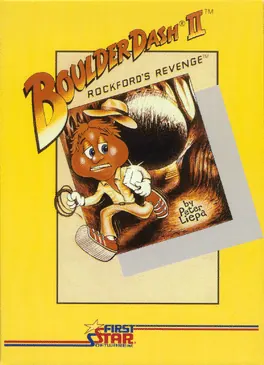
Boulder Dash II: Rockford's Revenge
In part two of the "Boulder Dash" series, game design hasn't changed compared to part one, so you still have to mine diamonds while avoiding falling rocks and cave monsters of all sorts. As in part one, later levels become more difficult because many puzzle elements are added.
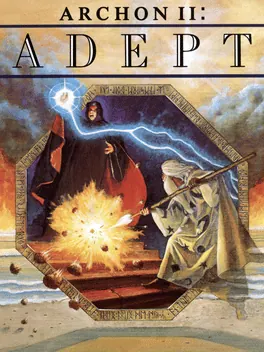
Archon II: Adept
Archon 2 or also Adept is the successor of the successful Electronic Arts classic Archon. As already seen in Archon, an apocalyptic fight takes place in a fantasy surrounding, now not between "light" and "dark" but between "order" and "chaos". It all happens in a game area which is divided into 4 elemental layers. In the center is the earth layer, it is surrounded by the water layer and this is surrounded by the air layer. The outer layer is made of fire. Opposite to its forerunner the players start in Adept only with one magician ("Adept") per layer. All the other creatures have to be conjured in the course of the game. Evocations and other spells cost energy, which is renewed by occupying energy points on the game area with your own creatures. The more points you occupy, the more energy you get. Every side possesses 4 own elemental beings, which have a special force when they are on their corresponding layer. Moreover 4 different demons can be conjured from both sides, which can fight independently from the chosen element. Many of these creatures can use a shooting attack, but they have also lots of special attacks. When two figures meet on a field, here also the screen is zoomed and a fight for life and death starts. The winner claims the hard-fought field. Dependent on the layer you are fighting on, the battlefield has different obstacles such as slowing-down lakes, shoot destracting swirls, flame walls or simply walls ready. The only exception are the two void fields, here no terrain is used
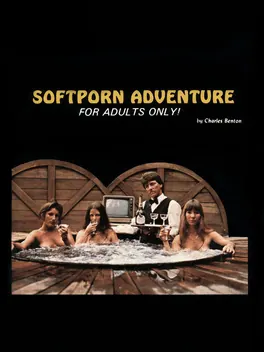
Softporn Adventure
A text based adventure game released in 1981 and has similar content to "Leisure Suit Larry in the Land of the Lounge Lizards" developed by Al Lowe which is based on "Softporn Adventure". It was ported to PC in 1991 and has also been included in some Leisure Suit Larry Collection editions.
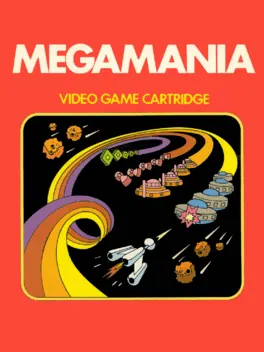
Megamania
In Megamania, the gameplay resembles that of Space Invaders. Rather than being aliens or spaceships, however, the enemies in this game are various objects such as hamburgers, bow ties, and steam irons. The object is to shoot them down before the energy bar at the bottom of screen is depleted, all while avoiding the oncoming enemies and their own projectiles attacks. Each of the enemies fly in select patterns and as soon as they hit the bottom of the screen, they re-appear at the top until shot by the player. The player's spacecraft depicted in the game is a cross between the U.S.S. Enterprise and Klingon battlecruiser from the Star Trek universe. Gameplay-wise and in terms of graphics, MegaMania bears a very strong resemblance to Sega's 1981 arcade title "Astro Blaster". Both games feature nearly identical patterns of approaching enemies with the player relying on an "Energy" meter. Also, the player's ship bears a remarkable similarity in both games. When Megamania was originally sold, anyone who scored above 45,000 points could send Activision a picture of their screen and become an official Megamaniac. They also would receive an Official Megamaniac emblem.[2] If a player exceeds a score of 999,999 the game ends.
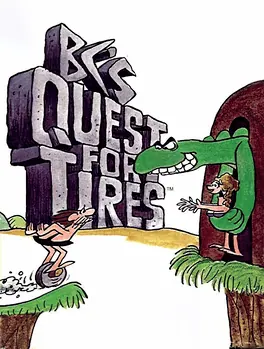
B.C.'s Quest for Tires
Cute Chick is in trouble! She is being held captive by the dinosaur, and it is up to Thor to ride his trusty wheel to the rescue. There are many obstacles in the way which Thor will need to jump and duck, including rocks, trees, rivers, lava pits, cliffs, and of course Fat Broad. When you duck, the character bounces up and down, so don't duck too soon. BC's Quest For Tires is a side scrolling action game resembling Moon Patrol in some ways, featuring characters from the comic strip BC.
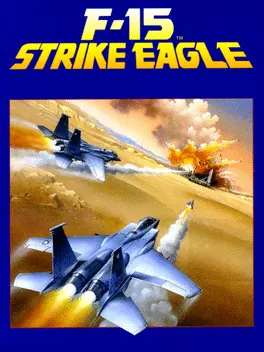
F-15 Strike Eagle
F-15 Strike Eagle is an F-15 Strike Eagle combat flight simulator first released in 1985 by MicroProse. It is the first in the F-15 Strike Eagle series comprising also the sequels F-15 Strike Eagle II and F-15 Strike Eagle III.
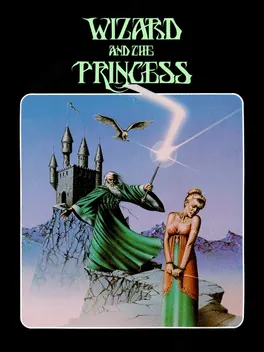
The Wizard and the Princess
Princess Priscilla has been kidnapped and the player seems to be the only valliant hero willing to rescue the damsel in distress. This is the second text adventure with illustrating graphics released by Sierra. Communicating with the game works via entering commands which tell the player's alter ego where to go and what to do. Since the parser is a very basic one it only understands two-word commands. Two years after its initial release, the game was renamed "Adventure in Serenia" for its PC release. This suggested sequel was, however, exactly the same game as in its previous incarnation.

Chuckie Egg
Chuckie Egg is an action platformer featuring a turn-based multiplayer mode. As Hen-House Harry, the player must collect the twelve eggs positioned in each level, before a countdown timer reaches zero. In addition there are piles of seed which may be collected to increase points and stop the countdown timer for a while. The player starts with five lives, and an extra life is awarded every 10,000 points.
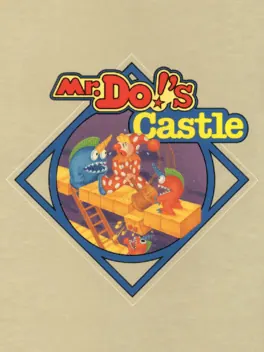
Mr. Do!'s Castle
Mr. Do!, that king of arcade clowns, is in a bit of a bind - again! This time, a pack of pesky unicorns is trampling the bricked hallways of his castle. Help Mr. Do! rid his dwelling of these crafty, quick-changing (and deadly) creatures with the skillful swing of a hammer. Sometimes a quick clobber to the head will do it. Or maybe a well chosen brick knocked out from above. If you can't stop these critters, then break a hole in the floor to slow 'em down. It's up to you to know when to fight - or when to flee! Tension mounts as you hurry Mr. Do! through the castle's maze, grabbing keys along the way. Only when Mr. Do! has collected all the keys can he unlock the castle door, and open up an extra chance to beat these nasty critters!
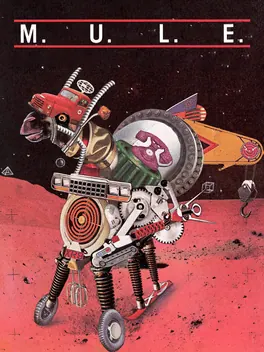
M.U.L.E.
M.U.L.E. is about four hopeful explorers trying to make a fortune on a virgin planet. This is done by producing various goods (Food, Energy, Smithore, Crystite). Each of these goods have their uses: if you don't have enough food, you will have less time during your turn. If you don't have enough energy, your output will be lower. If enough smithore isn't produced, there will be a shortage of M.U.L.E.s. Crystite is the big earner that can make or break your game. You start the game by selecting your race. Some are easier to play, some harder. There are three levels of difficulty, in the easiest the game only lasts 6 turns, but the real game is 12 turns. Crystite is not available at the easiest level. Each turn starts with land claim. Each player gets to choose a spot of land for themselves from the map. If two players choose the same spot, the player with less money wins. The map consists of different landscape. River is best for producing food, plains for energy, mountains for smithore. Crystite is hidden and must be first found by taking a land sample to the town. After the land claim each player takes turns in cultivating their land and do other tasks. They can buy M.U.L.E.s to start production on their land, sabotage other players by buying M.U.L.E.s and letting them loose, try to catch the Wumpus for cash and try to find crystite veins. The time to do these things depends on if the player has enough food. Finally the player goes to the casino and wins a small amount of money, depending on how much time was left.
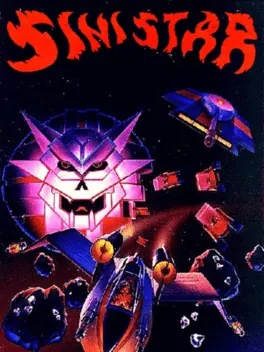
Sinistar
The player pilots a lone spacecraft, and must create "Sinibombs" by shooting at drifting planetoids and catching the crystals that are thereby released. Sinibombs are needed to defeat the game boss, Sinistar, an animated spacecraft with a demonic skull face. Sinistar does not exist at the start of the game, and is continuously under construction by enemy worker ships. Though time is crucial, attempting to mine too quickly will destroy a planetoid without releasing any crystals. Enemy worker ships are also gathering crystals (often stealing them from the player) which they use to construct the Sinistar. Enemy warrior ships can directly attack the player's ship. The player is given a head-start before the enemy ships have enough crystals to begin construction. Game ends when the player's ships are all destroyed. Once the Sinistar is completely formed, a digitized voice makes various threatening pronouncements, including "Beware, I live!," "I hunger, coward!," "I am Sinistar!," "Run! Run! Run!," "Beware, coward!", "I hunger!," "Run, coward!," and a loud roaring sound. The Sinistar has no weapon attacks, but if it contacts the player's ship while it darts about the playfield, the player's ship will be "eaten" and destroyed. A total of 13 Sinibombs are required to destroy a fully built Sinistar, although an incomplete Sinistar can be damaged to slow construction. Each short-range Sinibomb automatically targets the Sinistar when fired, but can be intercepted by a collision with an enemy ship, enemy fire, or a planetoid. The player moves from one zone to the next each time he defeats the Sinistar. A sequence of four zones repeats continuously after the first zone. Each is named for the most numerous feature of that zone: Worker Zone, Warrior Zone, Planetoid Zone, and Void Zone (the Void Zone is especially difficult because it has very few planetoids). Beginning with the first Worker Zone, a completed but damaged Sinistar can be repaired/rebuilt by the enemy ships by gathering more crystals, extending its "lifespan" if the player is unable to kill it quickly.
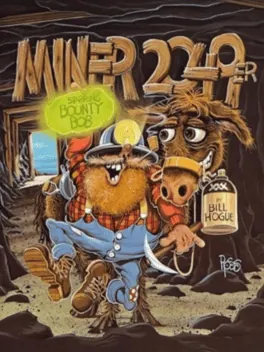
Miner 2049er
"Bounty Bob" is mining a radioactive mine in the year 2049. Help him "claim" all of the various stations (multiple screens). Avoid contact with the deadly mutant organisms by running away, or hopping over them. Collect various articles left by previous miners for bonus points.
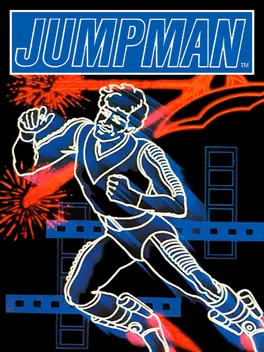
Jumpman
Jumpman is a platform game written by Randy Glover and released by Epyx in 1983. Originally developed for the Atari 8-bit family, versions were also released for the Commodore 64, Apple II, IBM PC, and ColecoVision.
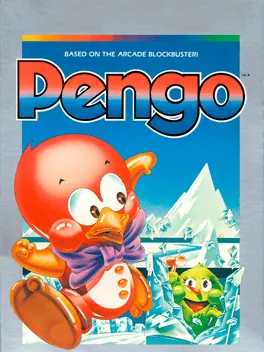
Pengo
The player controls Pengo, a red penguin that resides in the Antarctic. The game takes place in an overhead maze made of ice blocks, where Pengo fights the trolling, blob-like Sno-Bees. The objective of the game is for Pengo to survive a series of rounds by eliminating all Sno-Bees, while amassing bonuses by bringing together the three diamonds dispersed in the maze.
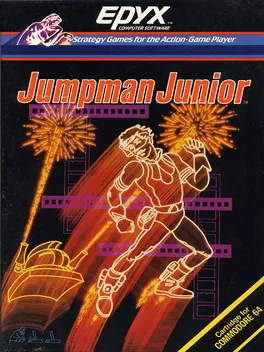
Jumpman Junior
Jumpman Junior is the sequel to Jumpman and features similar gameplay with all new levels. As Jumpman, your goal is to disarm all of the bombs on the level before time runs out. Each level consists of a variety of platforms, ladders, and ropes you will need to jump and climb to reach the bombs. To make the game more challenging, a bullet will fire on the screen from time to time which will cause Jumpman to lose a life if hit. Each level has a different theme to it, and a few also have additional dangers as well. You will encounter deadly fires, the bouncing hellstones, moving ladders, disappearing platforms, and more.
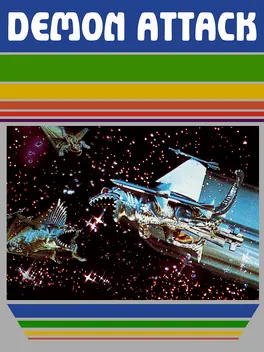
Demon Attack
Demon Attack is an arcade action game with gameplay similar to Space Invaders. You control a laser cannon at the bottom of the screen, and need to destroy wave after wave of brightly colored demons. The demons bounce around the screen in bizarre patterns, and try to destroy your cannon with bombs or lasers. When you shoot a demon, it will be replaced with another or will split into two smaller demons depending on which wave you are playing. When the required number of demons for the current round is finally destroyed, you can move on to the next, more difficult round.
Spelunker
A miner has to find the exit to a world of wonders that is deep in the ground. During his journey he has to collect bombs to destroy rocks in his way, collect keys to open doors and pick up little potions that refresh his timer. Treasure chests can be opened for bonus items.

Beyond Castle Wolfenstein
Like its predecessor, Beyond Castle Wolfenstein is a combination action and adventure game. It is set in World War II during Adolf Hitler's rule as Chancellor of Germany. The objective of the game is to traverse all the levels of the secret Berlin bunker where the Führer is holding secret meetings with his senior staff. The player must retrieve a bomb that the operatives have placed inside the bunker and place it outside the door of the room where Hitler is holding his meeting, a scenario bearing a passing resemblance to the July 20 plot.
Zork III: The Dungeon Master
In the third game of the adventure game series Zork, you are once again a nameless adventurer, only this time you won't travel through a beautiful magical land, but are immediately cast into a deep dungeon. Like in a dream, you hear a mysterious voice telling you that you have passed all the tests but one. When conscience returns to you, you find yourself on the endless spiral of stairs, with only your trusty lantern near you... will you be able to survive the horrors of the Dungeon?
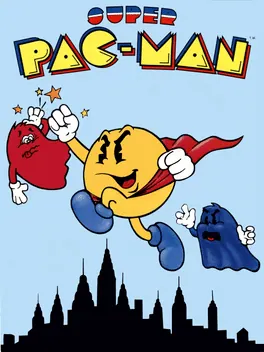
Super Pac-Man
Super Pac-Man is a game in Namco's Pac-Man family, but instead of gobbling up dots, Pac is required to eat fruit and prizes, such as apples, bunches of bananas, doughnuts, hamburgers, fried eggs, ears of corn, sneakers, pieces of cakes, raspberries, limes, cups of coffee, mushrooms, Galaxians, bells, and shamrocks. Most of these items are hidden in passages that have locked doors at either entrance, and in order to unlock the doors, Pac needs to eat the key that is closest to the passage that he wishes to unlock. As usual, ghosts will keep chasing Pac around the maze until he has lost all his lives. However, Pac can enter the warp tunnels at either side of the maze to lose the ghosts quickly. There are two types of power pellets in the maze: green and yellow. Yellow power pellets cause ghosts to turn blue, allowing Pac to eat them for points, whereas green ones cause Pac to enlarge and will also cause the ghosts to become much thinner and wider, allowing him to fly over them. He can also break open the doors without the need of keys. The effects of the pellets, unfortunately, only last for a number of seconds. During the time that he is enlarged, a flashing star will appear besides two boxes that are located in the middle of the maze. The first box will display the current fruit or prize, and the other will display a rotating selection of them. If Pac manages to eat the star when they match there will be a large bonus score. Occasionally, after three or more stages, there will be a bonus stage where Pac automatically gets enlarged. The object of these stages is to eat everything in the maze before the time runs out and, during these stages, there will be no ghosts to pursue him.
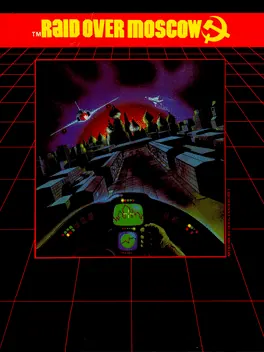
Raid over Moscow
Released during the Cold War era, Raid Over Moscow is an action game in which the player (an American space pilot) has to stop three Soviet nuclear attacks on North America, then fight his way into and destroy a nuclear facility located in Moscow's Kremlin. According to the game's storyline, the United States is unable to respond to the attack directly due to the dismantlement of its nuclear arsenal.
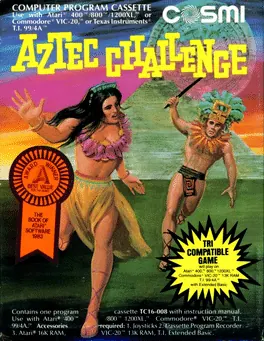
Aztec Challenge
In the Aztec empire you were chosen for sacrifice. A forthcoming violent death you can only escape when a risky obstacle course face - the "Aztec Challenge". But that is no picnic: at the beginning it will be from "all sides" . pelted with spears, while one has to work its almost endless way to the temple Once there it is not friendly: trapdoors, falling boulders, snakes and spiders waiting for new victims. it is a moral imperative and a two-player mode - unfortunately alternate the players then only from. the game features 7 breathtaking levels (plus end bonus), in which a good reactivity is required. The graph corresponds unfortunately only the ordinary 1984, but does not spoil the good game idea. Moreover, good acoustics for the right mood makes. Ideal: one has reached a higher level, you do not have to start again when all lives are exhausted.
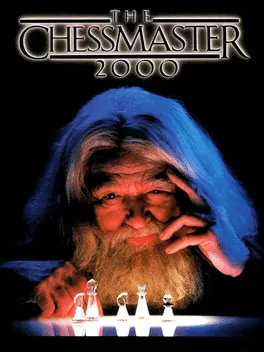
The Chessmaster 2000
The Chessmaster 2000 is the most powerful computer chess program in the world today and the friendliest! It draws from a mammoth opening library of over 71,000 moves - the world's largest. In mid-game, it displays amazing combinations of classical and modern strategy. At end game it calls further upon the world's newest and finest computer chess algorithm to mount virtuoso tactics.
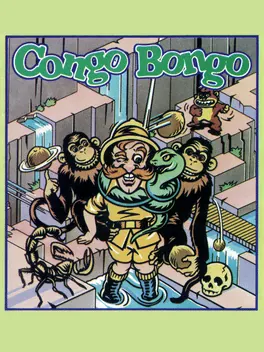
Congo Bongo
Congo Bongo is an isometric platform arcade game released by Sega in 1983. The game has come to be seen as Sega's answer to the highly successful Donkey Kong game that was released two years prior. The player takes the role of a red-nosed safari hunter who tries to catch an ape named "Bongo". The hunter seeks Bongo to exact revenge for an apparent practical joke in which Bongo set fire to the hunter's tent, giving him a literal "hotfoot". The game was named by Peter W. Gorrie who was the CFO of Sega at that time.
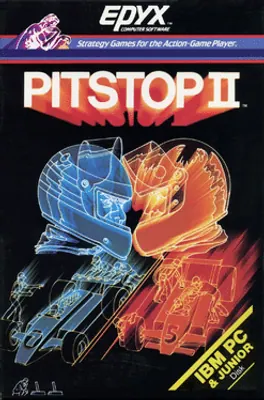
Pitstop II
Pitstop II is the first 3D racing game to implement a split-screen simultaneous two-player game mode. Players could be in completely different places on the racing track, and each split screen would show the view of the track according to the player's position.
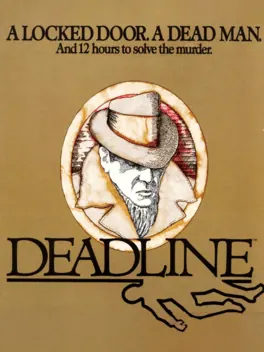
Deadline
Deadline is an interactive fiction computer game published by Infocom in 1982. Written by Marc Blank, it was one of the first murder mystery interactive fiction games. Like most Infocom titles, Deadline was created using ZIL, which allowed the easy porting of the game to popular computer platforms of the time such as the Apple II and the Commodore 64. It is Infocom's third game. The player's character in Deadline is an unnamed police detective, summoned to a sprawling Connecticut estate to investigate the apparent suicide of wealthy industrialist Marshall Robner. At first, it seems a very straightforward case: the body was discovered in the library, which had been locked from the inside, and the cause of death was an overdose of his prescribed antidepressants. But something just doesn't feel right. Could someone have killed Robner for his money? Did he make an enemy through his business dealings? Or was there some other motive? With the able assistance of level-headed Sgt. Duffy, the player has twelve hours to solve the case before it is closed forever.
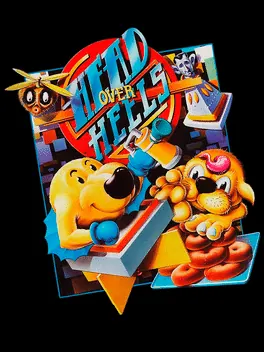
Head Over Heels
Two distinct characters called Mr Head and Mr Heels are played in this arcade adventure. They are separated at the shoulders but capable of joining together to maximize their abilities in some situations (but reduce them in others, so they can be split again). The game is presented from an isometric perspective, and presents the characters with a number of puzzles involving switches, jumps and climbs. The levels are 3 dimensional, and the characters must collect crowns as they progress. Objects can be picked up and manipulated as necessary.

Basketball
Basketball is an Atari 2600 game loosely based on the sport of the same name. The game features a simple game of one-on-one basketball playable by one or two players, one of the few early Atari 2600 to have a true single player feature with an AI-controlled opponent.
Blue Max
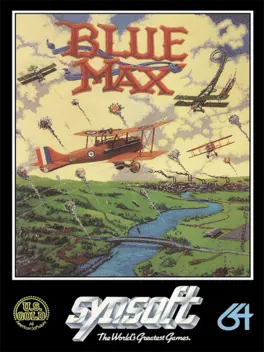
Blue Max is a video game developed and published by Synapse Software, originally released for the Commodore 64 and Atari 8-bit computers in 1983. In 1984 it was ported to the ZX Spectrum by U.S. Gold. in 1987 Atari Corp. published it in cartridge form for the then-new Atari XEGS. The player controls a Sopwith Camel biplane during World War I, attempting to shoot down enemy planes and bomb targets on the diagonally scrolling terrain. It has strong similarities to the arcade game Zaxxon. The game is named after the medal Pour le Mérite, informally known as Blue Max. Its theme song is "Rule, Britannia!". In 1984, Synapse released a sequel called Blue Max 2001 with a futuristic sci-fi setting, but otherwise similar in style to the original game.
The Hitchhiker's Guide to the Galaxy
The Hitchhiker’s Guide to the Galaxy is a classic Interactive Fiction game. Though divergent from the source material, the main characters, locations, and concepts are here. Unlike the book, death can come quickly if Arthur fails to observe his surroundings, collect inventory, talk to people, and consult the Guide. Don't panic!
3-D Tic-Tac-Toe
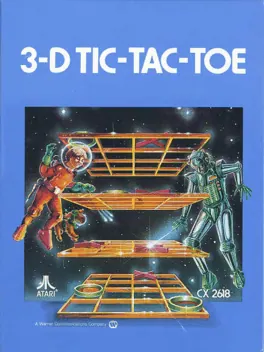
The game is similar to the traditional game of tic-tac-toe, but is played on four 4×4 grids stacked vertically; it is basically a computerized version of the board game Qubic using traditional tic-tac-toe notation and layout. To win, a player must place four of their symbols on four squares that line up vertically, horizontally, or diagonally, on a single grid, or spaced evenly over all four grids. This creates a total of 76 possible ways to win, in comparison to eight possible ways to win on a standard 3×3 board. The game has nine variations: it can be played by two players against each other, or one player can play against a built-in AI on one of eight different difficulty settings. The game uses the standard joystick controller.
Montezuma's Revenge featuring Panama Joe
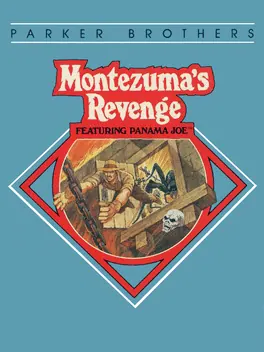
PANAMA JOE, That’s what they call him ‘round these parts; though no one knows his real name or where he comes from. But one thing’s for sure, PANAMA JOE’s a daredevil from the word “go!” No risk’s too great if the reward’s large enough. Winning. That’s what’s the most important to him. And more times than not, that’s exactly what he does. Because he’s tough, clever – resourceful. And sometimes, downright pig-headed! Though occasionally (ah-hum), he’s been known to get in over his head. Luckily, he’s got a knack for getting himself out of hot water as quickly as he gets into it! Let’s hope MONTEZUMA’S REVENGE is one of those times.
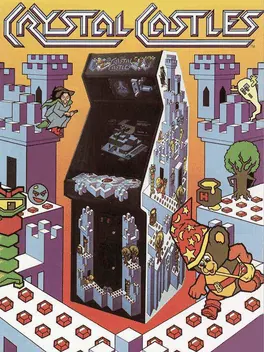
Crystal Castles
Crystal Castles is an arcade game released by Atari, Inc. in 1983. The player controls a cartoon bear by the name of Bentley Bear, who has to collect gems located throughout trimetric-projected rendered castles while avoiding enemies out to get him as well as the gems. Crystal Castles is notable for being one of the first arcade action games with an actual ending, whereas most games of the time either continued indefinitely, ended in what was termed a "kill screen" or simply just restarted from the first level, and to contain advance warp zones.